Have you noticed today, broadcasters, television and radio reporters, commentators or pundits will often describe something as "worrying"? Example: "The latest report is even more worrying."
Or, one will frequently hear "worrying's" new synonym, "concerning" as in "it's very concerning." This is coinage at its worst. Bad habits, those of you who report or analyze the news.
"Worrying" sounds awkward. Why not use "worrisome"?
And, regarding "concerning," indeed, the word is more correctly used as a synonym FOR "regarding."
Example: "concerning" tonight's agenda or "regarding" tonight's agenda. Furthermore, journalism friends, some of us think "concerning" should never be a synonym for worrisome.
Why not use "disconcerting"? "Images from the scene are disconcerting." Or, "Of greater concern, are the graphic images."
Not, "The graphic images are concerning."
Your blogger's pet peeve for the week
Sunday, February 28, 2016

Friday, February 5, 2016
As Was Their Habit
From our Aunt Bea's Plymouth Collection


She shivered––not from the cool of the morning but rather the prospect of her daughter falling and thrashing about in panic out there. Though two decades has passed since her own dunking, the memory of the lake's limitless breadth and darkness endured.
But, Jennifer possessed maddening confidence about these things. Such bravado her mother had to admire, though she still ranked waterskiing with rock climbing and certainly bungee jumping.
Jenny stirred the golden water into a gentle meringue, skiing behind the boat of a new friend, a young man she'd met in the library several months ago. This, his first visit to the lake but he seemed confident as when they first met him at the Authors and Chocolates event, confident enough in these unfamiliar waters.
He carved the broadest sweeps and Jenny trailed behind his craft, flexing in harmony with the chop off the water, her skis her wings. He called to her, using the electronic megaphone he brought with him this morning.
He insisted on the megaphone as a key safety measure––one their daughter pooh-poohed but relented when her parents appeared so impressed with the precautions taken on her behalf. Thoughtful. Considerate. Responsible. Good qualities. Approvable.
"What are you doing?" Her husband sipped the morning coffee with a frown, letting his open newspaper brush the floor.
"I'm riding with her," she announced, continuing to bend her knees as she stood between the open French doors. "See? I'm bouncing over the waves and the skis are going, 'ka-wumpf, ka-wumpf.' and I'm nearly breathless from the spray––oh!––it is so exhilarating." She sprung up and down, her legs remembering an old warm-up from their days at the rail, Miss Ballinger's ballet class.
"Hah! I thought you were playing the cello."
"Are my legs that bowed?"
"Your legs are more supple than these football knees––creak with every bob she takes out there. "He settled into his favorite wicker chair. "But you, . . ."he folded his newspaper and creased it as was his habit. "You've always feared the water."
"I prefer gazing at the lake, not swallowing it," she told him. "Learned my limitations, as you say."
He scowled into his coffee cup."What am I drinking?"
"It's the new brew I picked up yesterday. It sounded festive––'Caribbean Nights.'"
He snorted and creased the paper again, to the page where a respected columnist held forth. "It's good," he said of her brew. "Glad it's not 'Sweepings Off the Jungle Floor.'"
When she took her place across from him, she lifted her own cup and bestowed that "I-want-to-talk-about-something" smile upon him. The boat droned on, growing fainter with each sip. She cradled the mug, as was her habit, and watched him follow the column down until he signaled with a smirk of approval that this week's commentary was worth the effort of both writer and reader.
Finished, he looked up at her over what he called his "Fessiwigs," the half-framed eyeglasses he now wore with greater frequency. "What?" he asked.
"What do you mean, 'What?' ?"
“You know what.”
“Why, no, sweetheart.”
“The devil. What are you thinking?”
“Nothing.”
“You were smiling.”
‘I’ve been thinking.” She set her mug on the white wicker table between then and leaned towards him, cradling her best feature, that delicate chin where the mug had been. This, she knew, her most effective and characteristic “I’ve-been-thinking-and-I-want your-reaction” coquetry.
“All right then, about what?”
“About us . . . and them.”
“Them.”
“Yes, them. Mostly.”
“Well?”
“He’s being careful, just as you would. And I’m struck how . . . right she looks out there. On the water this morning.”
“She’s an athlete on land or sea.”
“And that comes from your side. My people were the painters and poets.”
“Artsy,” he offered.
“If you like. Refined.”
“Told y’ before. We Hanlons––we’re a race of brutes. Big, rough. Even our women were raw-boned––take my mother. Jenny gets her grace from your side.”
“What if I had been lanky and big-boned. Would you have married me?”
“Oh, lord.”
“Well?”
“Why bring that up?” He returned to his newspaper.
“Well? What?” She teased, cocking that eyebrow.
“How you do beguile.”
He flipped the paper out to leaf through its pages of state and national items, his least favorite sections read more out of duty as a decently informed citizen. He scanned the headlines, putting her off, his turn to tease. “Still at it?”
“Yes.”
“Why?”
“I’d . . . just like to know.”
“We’ve been over this, dozen different angles.”
“What? Not this exact subject.”
“This, ‘would-you-marry-me-if?’ business.”
“Yes, but a girl likes to hear it.”
“Romance seems to be in the air,” he coughed and set his paper aside, leaned back, stretching until the wicker chair squeaked. “We had to inject some genes that would soften my side. Find a mate to whelp us some decent features . . . nice profiles and good markings.”
“Glory!” she laughed. “And are you through breeding the old bitch? Or do you need another litter?”
“Nah. She’s done her part.”
She picked up her mug, toasted him and he returned the mocking gesture. “It is good, Jack.”
“What’s good?”
“‘Jungle Floor’.” She rose and took her pleasure from the lake now basking in the warmth of a midsummer’s day. The boat was returning and she followed its progress toward shore through the binoculars they kept close to the porch for bird sighting and deer watching.
“She looks like Angela out there,” she told him while keeping their daughter in focus.
“I’ve said so twenty times, have I not? Those two could be mother-daughter rather than aunt and niece.”
She lowered the big lenses to her chest. “Jenny could have children.”
“Jumpin’ the gun, aren’t y’?”
With the naked eye, one could tell the skiing was over, successfully, safely. And so, she trained the powerful glasses on her daughter first, now neck deep in the quiet water. then to the boat and the young man maneuvering to her side. He pulled her up and over, lifting her, soggy wetsuit and all, into its cushioned interior.
“Well,” the mother in her sighed.
“What?”
“A relief. She looks . . . radiant.”
“Quit spying,” he scolded.
“Not spying. Just gaining some . . . insight.”
“Spying.”
“And you’re right––Angela is her spitting image these days. You can really see it in the morning light. Come see.”
“Yeah, yeah.” He waved it off, his typical gesture of dismissal.
“You’re being ‘grimcheux papi’ today.
“Hah!”
“Just as Angela says. Your granddaughter knows you––”
“––What she knows . . . is all the claptrap the women of this family feed her.”
“Wasn’t that just precious, though, Jack, really? ‘Faux Grumpee’, a granddaughter’s assessment of her granddad’s demeanor last summer? Oh, she has you figured, you and your veneer.”
“Figured how to coax and wheedle and finagle, just like all the other females in this clan––”
“––It’s in the genes, dear. Those refined and sensitive traits we’ve supplied for the benefit of you brutish Hanlons.”
“So, now we can sire perceptive, intuitive, finely crafted . . . .”
“Exactly.”
“Works of art,” he concluded.
“Isn’t it wonderful? Jenny and then Angela and before then her clever mother.”
“Ten-year-old spouting off, trying to speak French. The language of diplomacy and all the more conniving––precocious little show-off.”
“Oh.” She screwed down her most exaggerated pout. “So mean and grumpee papi we are. Remember––?”
“––Chirpy grandchildren, today. What ever happened to ‘Should be seen and not heard.’?”
“That old saw went out with the wringer washer. Remember? ‘Now grandpa, we’re not going to be a grumpy granddad like you see on t. v., are we?’”
“Presumptuous little squirrel, her.” She caught the smirk he couldn’t hide.
***
The boaters were approaching the dock, and he glanced toward their arrival through the spokes of the deck railing. He sighed: how to react, how to regard this young man now in their Jenny's life?
“She could have children. Hmmm.” she said wistfully.
“It would be hard, love. Be a struggle for the both of them.”
“Yes, but she’d have us. She’s lucky we’re so close by.”
“And, . . .” he had returned to his paper, rustling it vigorously, “we’re lucky to have her.”
“What do you think?”
“What? Think what? Don’t get dreamy over there.” He could read her smile through simply hearing the undertone. No need to look up.
“They could get married, why not?”
“Dunno. He’d be taking on quite a load.”
“Well, it’s not like she’s dependent. She’s become self-sufficient basically. They could . . . thrive. We’d help.”
“Bridle that enthusiasm, girl.”
“There are hurdles, certainly. But they can be conquered. My goodness, look at all she’s done with herself. Out there today, waterskiing, for heaven’s sake. I can’t do that . . . but she can.”
He felt her reading him, luring him into some comment beyond a quick brush-off, some commitment which if not profound or enduring, would at least be important and positive enough for the both of them.
“You’re hopeful for her, aren’t you?” she asked.
“Of course. She’s as deserving as anyone, moreso than most. But there’s one thing we cannot give her, and that’s happiness with some good man.”
She scooted to him, wrenched the wicker chair around, and perched on its edge so their knees touched. Then she grabbed up their mugs of cold coffee, handed him his, and they clinked them together.
“Over the gums!” she piped
“Look out stomach,” he growled, voicing the line he was assigned. “Gol, you do get the bee in your bonnet,” and he swirled the mug’s contents, then swigged it all the way.
She jumped from her chair and ran to the deck’s railing. “Come on out! Come out to the sun,” she called.
“Yes,” he said and sighed flatly.
That she had returned to the French doors and waited for his compliance was fully expected. And he knew she would say nothing. She’d stand there, arms folded, leaning against the doorjamb, perhaps tapping a toe faintly. No escaping it.
“Now quit that spying.” He peered over his “Fezziwigs,” projecting he thought, his sternest expression.
She placed her hands behind her and leaned squarely against the door, that chin tucked under those soulful eyes. This gray-haired girl, he decided, remains as fully distracting as that night in the student union so many years ago.
He rose, tossed the sports section on the wicker divan for later and padded out behind her to greet the couple coming up the dock.
“He’ll have to get used to Ralph and Ralph to him,” he told her as they watched the young pair approach wth the big tawny dog at her side.
“Oh, that will happen. And Ralph loves boating, you proved that. I think they’re friends already.”
“Umm, not likely, pet. He’s devoted to one person and one alone. It’s their training.” He knew Ralph, her dog, could be offish, not threatening of course, but indifferent when others were around. His loyalty encompassed only Jenny, his mistress, not other members of the family.
And as Jack watched the trio climb the hill to the house, suddenly his throat grew tight and eyes welled.
How good and true was their daughter’s helper and friend! How deep its devotion and how inseparable they had grown over the years. And how observant of those ancient breeders to call his kind, “The Shepherd.”
For such was Ralph’s lot, guiding her up and down the steps of life, gentle yet firm and strong, her daughter’s constant companion. How willing to sacrifice a dozen, perhaps a hundred, more carefree dog lives than the one chosen by man for him. How easily he accepted the harness, the task hourly, daily, and how tirelessly he rose to her command.
My God, what fool could dare say animals have no souls?
He knew the wife at his side caught the tear glistening on that bright Sunday morning––he did not care––and when their daughter waved up at them, it seemed as if she could see again.
“How did she know to wave?” he asked, wiping his eye.
“She felt him wave.”
“He told her to.”
“No. She felt it. It’s instinctive.”
“Kind of a woman’s thing, I guess.”
“Yes, perhaps. Being blind helps.”
The young couple and the dog disappeared around the blue willow hedge that embraced the deck there. He told her: “Thank you.”
“For what?”
He didn’t answer.
“For what, hon?”
“I’d rather not discuss it right now.”
(When Aunt Bea and I called on the Hanlons one morning, they were leaving for a trip to visit Jenny and her new husband. This short story was developed from that brief encounter.
The dog pictured above could have been Ralph.)
Monday, December 7, 2015
The Boys of Summers Run, a novel swimming upstream

The Boys of Summers Run is written for seniors . . . parents . . . grandparents . . . middle-grade teens . . . and boys, likely the reluctant readers in most households.

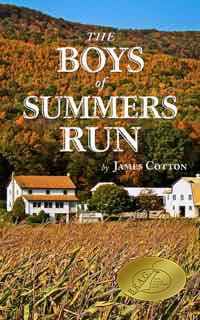
The back cover reads:
Fatherless boys become the Four Horsemen of the Outfield
Autumn, and high above the fields and forests of his family's historic farm, Claude Kinkade surveys his life there thus far. His future in rural Pennsylvania remains cloudy. His mother's marriage may move him to the deserts of Las Vegas and far away from his beloved Little League Baseball team, the Panthers.
Worse, Claude's loyalty is spreading its cloak over Shadeland, his father's ancestral acreage. He senses his departed father's shadow following him as he becomes the "farm-boy-in-training" of Summers Run. Must he forsake the memories he yearns to make among the Clan Kinkade? Will Shadeland suffer in his absence?
"Runs" are the brooks and streams linking the countryside together in Claude's new world. Summers Run is one of these, and The Boys of Summers Run is a story of deep roots and timeless springs, nurtured by traditions of family and folkways. It describes the friendships only boys can forge while learning of life and loss, the triumphs and tragedies of it all. One unsolicited reviewer writes:
"I think this is the best book I've read in a long time. I enjoyed it because it taught so many lessons. . . . I would recommend this book for all ages."
Be aware Boys is not a sports story. Nor the typical coming-of-age account. It is a story of a family preserving the land and the values it is duty-bound to protect and honor.
Be aware Boys is not a sports story. Nor the typical coming-of-age account. It is a story of a family preserving the land and the values it is duty-bound to protect and honor.
To order from Barnes & Noble: The Boys of Summers Run
From Amazon: The Boys of Summers Run
From IndieBound: The Boys of Summers Run
(IndieBound is a huge community of independent bookstores found in your hometown and on the street corners across the nation. IndieBound members offer all manner of book services, shipping, and ordering of ebooks for your tablets and readers or softbound versions for your nightstand. Patronize them whenever possible.)
From Amazon: The Boys of Summers Run
From IndieBound: The Boys of Summers Run
(IndieBound is a huge community of independent bookstores found in your hometown and on the street corners across the nation. IndieBound members offer all manner of book services, shipping, and ordering of ebooks for your tablets and readers or softbound versions for your nightstand. Patronize them whenever possible.)
Sunday, December 6, 2015
Aunt Bea's Plymouth: "The Gad-abouts"

Somewhat strange, I suppose, for a twelve-year-old to tag along with his aunt as she made her rounds for the church. Yet, calling on old members and friends, new families fresh with babies or Beagle pups, farm folks and city dwellers––every visit made a memory for me.
One could peek down the hall or up the stairs of the homes we entered. I'd note the Victorian antiques or if the television was a DuMont, Philco, GE, RCA, Sylvania, or an Emerson. Then record what calendars or portraits hung on the wall, find the creaks in the hallway, smell the aromas that clung to the wallpaper.
Church visitation was no respecter of persons: some homes reeked of old times and infirmities; others were upscale where finned Cadillacs were berthed and, on the Hi-Fi, lush violins played country club music to complement the plush draperies and polished heirlooms.
The Breathwaites lived close to the "fashionable" side of town and life back then. Often pictured in the Tribune, they could out-Carnegie Dale Carnegie, author of How to Win Friends and Influence People––a very popular book back in those days. They drove Buicks. A dignified Roadmaster sedan for Cecil; a smaller, sportier Century hardtop for Virginia.
We were ushered into the stone foyer just as Cecil's cousin was leaving, and my Aunt Bea was elected to negotiate an argument.
Yes, Cousin Jim told us, the elder Breathwaites were still holding forth on the family place. "Mom and Pop rent most of the land and pasture, and that's fine with me since I din't want to farm. And, . . . so here I am, trying to get these two down yonder to see 'em while they're still around."
"We're driving down soon's we can," Cecil laughed, embarrassed enough that even I could see it.
"That's what I heard the last time we had this discussion," Jim told us. "Every time we get into this."
"Jim," Virginia piped up, "we're busy people, just like you and Karen."
"I painted this house a year last summer," Jim told the both of us. "So I kept track of the to and fro around this place. Cecil would pull out, first thing in the morning. Then there goes Virginia, driving off. Cece comes back, then he leaves again. Virginia comes back. Cece drives back in, then Virginia takes off. Then Cecil takes off, and Virginia, in the meantime, comes back––"
Cecil shook his head and laughed, "Oh, Jimmy, now––"
"Y' might as well leave the garage door open––be easier. Needa traffic cop out here."
"Jim, we're social people––"
"Gadfly gad-abouts, I say."
"Well, you saw us on a Thursday and that's our busiest," said Virginia. "Miss Cotton knows all about how many things go on in this town." Jim started ticking off his fingers.
"They sing in two different church choirs, Presbyterian and Stone Methodist––practice every week for that. Then, Ginny plays the organ over at St. Paul's. They're both Gold Coaters, so have to get out and meet the tour buses comin' through. Then there's Rotary, and her garden club, Kiwanis, and the library board, something up at the college, and the Art and Book Guild, the Bird and Tree Club, the balloon fest, the pancake breakfasts––"
"And there's always work to be done and volunteers have to do it," Virginia pled her case.
'Well, Gin, let someone else take that stuff on." Jim scowled her way. "They pawn these jobs off on you two 'cause they know it'll get done."
"Jim, Ginny and I've talked about this very thing. We're going to bring the kids––"
"Dad's got four tracks for his trains now. Goes clear down one wall and around the corner, across the other. Mom's family tree quilt is done finally. Th' folks would be tickled to death to show those grandkids around . . . and get acquainted a bit."
"Yes, just as soon as they have a free weekend, we'll load 'em up––"
"Do it before they turn sulky, . . . couple pouty teenagers don't want to bother with us old duffers."
"We will, we will. We'll get it done."
Jim made his way to the front door of oak and wrought iron. "One of these days, Cuz, you're gonna get the call, 'The funeral's on Friday, hope yunz can make it.'"
The cousins said their goodbyes, and Aunt Bea and I were ushered into a den cozy with tartan upholstery, bookshelves built into the pickled oak paneling and a robust rock fireplace, trimmed in copper.
Church stuff took up most of the visit and most of which I don't remember. I do recall, though, the bit about pouty teenagers and pawning jobs off on folks entrusted and known to get such done.
Friday, November 13, 2015
Did You Miss This?
We posted this image and comment on another of our blogs, "A Feel Good Novel," but decided it deserved more exposure around and about.

Found on a pound of local coffee:
"The Danish word, 'Hygge' (hyoo-gah) symbolizes the art of inviting closeness and paying attention to what makes us feel open-hearted and alive. Hygge happens when we commit to the pleasure of the present moment in its simplicity."
Cherish moments. Live Hygge.
Tuesday, October 27, 2015
Aunt Bea's Plymouth

“Orlo and Eva”
“Oh, Miss Cotton, grand to see y’.”
“Well, Eva, so good to be here, and may I present my nephew, Jimmy. He likes to tag along.”
We were ushered into the dining area of the huge country kitchen where a sweating pitcher of lemonade awaited on a checkerboard table cloth. A cup full of spoons sat precisely in the confluence of red and white squares, the cup a fixture for the morning’s “coffee time” and, if the workload permitted, one in the afternoon. With a sigh, Eva heaved herself down to the table after pouring us the home-squeezed juice sweetened by sugar and a dash of maple syrup.
She was not a heavy woman, in fact, rather spare. But her manner told us she was dealing with weighty matters. Her complexion, flushed and dewy with exertion or concern, matched the checkerboard.
“I do need a visit . . . and I know you’ens will keep this to ourselves here.” She managed a smile in my direction. My Aunt Bea cocked her head, her gesture of concern and concentration. Eva smoothed the table top, clearing it of any ripples. “We’ve just had a family . . . well, not a rift. . . . Guess y’ might call it a ‘little tiff,’ or such like.”
“Oh, unsettling, those.”
“Yes’m. We finally got enough money from the insurance company to pay the kids a little wages after their old house burned down. An’ Bill, that’s our new son-in-law, asked Orlo if the check was for Linda too. Linda’s our daughter here on the farm,” Eva told me.
“So, Bill tells Orlo, ‘She’s been working as hard as I am.’ Well, truth of it, the kids have been working ‘specially hard, y’ know, cleaning up the mess over there and sortin’ through what they might salvage, plus all the haying and startin’ now on the grain. Linda milks in the morning and I try to help at night. That’s how we do in the summer when there’s so much to do.
“Well, Orlo came in all fussed up about it and said, ‘Guess Bill thinks Linda needs on the payroll now.’
“Orlo din’t know quite how to answer Bill. An’ later that next morning, Bill met me in the garden and said that he and Linda were a new ‘unit’ now and that since she got married, she can’t be what he called ‘your dutiful daughter any longer. When Linda and I married,’ Bill tells me, ‘it meant she became . . . separate . . . and needs to be paid by the farm for the work she does on the farm.’
“Well, I din’t know what to say neither. He said it nicely, kindly, but Orlo, like he does, got all huffy ‘bout the matter to me. He said, ‘I know there’s nothing writ down but we’re fair and honest people. Have been since we first settled this valley. Shysters didn’t last back then.’”
“An’ I told Orlo, ‘Times are a-changin’, Dad. Now I’m sorry we din’t pay them more like I wanted. It’s not easy, them just married and living in a tent.’”
“‘We’re gonna help them rebuild,’ says Orlo, meaning the money’s comin’ out of our pocket which is only right. An’ fair. We can’t expect those kids to pay much as they’re both just startin’ out an’ all.” Eva hoisted the pitcher and refreshed our glasses.
“I dunno. Family matters get complicated. Bill’s a nice enough boy and is educated about how things should be done these days.” Eva looked my way. “He just graduated from Penn State in the ag department. Orlo says books and lectures only go so far, that Bill would be better advised to shed some of those notions and accept things that are proven. What do you think, Miss Cotton? You’ens been through some of this, I ‘spect, coming from a big family an’ all.”
“Yes, one can have some misunderstandings, especially when there’s land and the farm involved and passing it down. The Cottons tried to be fair but realistic.”
“We only paid Bill $250 for nearly two months of work, hard work, way long hours. I din’t feel quite right about it but with the crops not in yet and Orlo death on going to the bank, it just din’t work very well right now. I told Orlo we prob’ly oughter pay Linda a little somethin’.
“An’ he just clammed up like he can and then y’ know nothing will get done unless everyone sees things his way. I dunno.”
“Perhaps, Eva, there’s someone you could talk to at the bank or with the county agent about wages and what arrangements some of the other families have made around here.”
“We might,” Eva nodded. “I might. I’m just afraid Bill and Linda might take a notion to move down with his people and settle there. There’s no place for them on the farm down there but they could get town jobs at State College, and he knows a lot of folks in the extension service. Problem is, we’ll need more help here some day as it’s gettin’ harder for Dad to roll out in the morning.
“An’ Orlo says, ‘Kids today gotta accept that farming’s their life and not their nine-to-five job. Y’ give up high wages and vacations to live on the place your forbears built for y’ and make it your own and for your kids some day.’”
“An’ I tell him, ‘We’re not getting any younger and what am I to do if you go first?’”
She stood and closed the kitchen window now being spattered by the afternoon shower. “Linda said the check was less than minimum wages today in 1955 and Orlo says right back, ‘Well, you’ll have a house soon enough, better’n the old house, plus there’s meals here and we pay the co-op for the lights an’ such. Gas to go to town, if y’ like.’
“I’m just afraid Bill will decide he’s just the . . . h-hired man around here and there’s no future,” Eva said over the quiver in her voice. “Bein’ a hiredee is not what I want for my daughter. My own father lived such a way and it’s no good for a man, not someone of Bill’s ambitions.” She leaned on the table and didn’t hide her anguish.
“Orlo’s aging and he won't go to the doctor. We both live in the past like it was today––I know we do.” Eva sat down and studied the checkerboard covering the worn and creaking table, then poured herself a lemonade to the rim.
“One thing, we gotta change the cows out, quit milking day and night and buy sucklers at the yard and let them graft when the cows freshen . . . I say. Orlo says, ‘Not until I cannot do it anymore. Those Guernseys are my father’s legacy and not to be abused with bein’ bunted around by a bunch of sickly Holstein calves and crossbred mongrels.’ So there we are and here we are,” she laughed. “Two hundred years of history and a hundred years behind the times.”
We left once the shower had passed on. As we drove down the lane and passed their mailbox, Aunt Bea noted the lettering: “Orlo Fisk and Eva”.
“That tells you a lot,” she said.
###
Wednesday, September 2, 2015
Award to The Boys of Summers Run
We're pleased to announce The Boys of Summers Run has been awarded a Medallion by a service supporting independent and self-published authors across the country.


BRAGMedallion.com is owned and operated by indieBRAG, LLC, a privately held organization bringing together a large group of readers, both individuals and members of book clubs, located throughout the United States and in ten other countries around the globe. The word "indie" refers to self or independently published books, while B.R.A.G. is an acronym for Book Readers Appreciation Group.
Its mission is to discover newly self-published authors and help them gain visibility and traction for their work.
Only 10 percent of the books submitted are awarded the B.R.A.G. Medallion and are presented on its website.
We are very pleased to be selected and included in this exclusive group of authors. The Boys of Summers Run is now listed on the website posted above.
When you arrive at the BRAGMedallion site, simply click on "Home" and you'll see The Boys of Summers Run listed.

Subscribe to:
Posts (Atom)